
July 30 – August 2
[googlemaps https://www.google.com/maps/embed?pb=!1m18!1m12!1m3!1d62518.398954504795!2d76.59504882639642!3d11.666043132087637!2m3!1f0!2f0!3f0!3m2!1i1024!2i768!4f13.1!3m3!1m2!1s0x3ba8adfd4a29090d%3A0xad56e301cc9c1720!2sBandipur%2C+Karnataka+571126%2C+India!5e0!3m2!1sen!2sus!4v1502946578295&w=400&h=300]
Bandipur Tiger Reserve was once a private hunting reserve for the Maharajas of Mysore. Today, it is a national park protecting many species of Indian wildlife. The public can take bus and jeep tours of the park to view the wildlife, and when we arrived late Sunday afternoon the visitor center parking lot was full.
A row of green guest houses lined the road on the far side of the visitor center. The one we stayed in was at the end of the row. It had two bedrooms with two twin beds each, and a bathroom attached to each bedroom.
The visitor center with its parking lot and tour bus hub, the row of guest houses, a cafeteria, and the highway made up a square around a large open field. A large herd of spotted deer (chital) that liked to frequent that area, as well as numerous wild pigs. Throughout the day they would rotate from the fields beyond the guest houses, into the center, and back out again with little concern for the people around them.
The other animals who had absolutely no concern about wandering among the tourists were the monkeys. They hovered around the parking lot like seagulls at a picnic, just waiting for the opportune moment. Unlike seagulls, they had the advantage of hands and feet, climbing over, around, and even into cars. A tourist who pulled up next to us set his coffee cup on the roof of her car for a moment, and the monkeys promptly claimed it for themselves. Another time, we saw a monkey climb in an open car window to steal a bag of candy.
We arrived at Bandipur around 4pm on the 30th, so Dr. Johnsingh decided we had time to go out on a jeep ride before dinner. Mervin and I sat on the back bench, raised up behind the back wheels high enough that my feet didn’t reach the floor, only the metal bar for a foot rest. We set off bouncing down the dirt forest roads, freshly muddy from a rainstorm. It was, literally, a bruising ride. But the scenery and animals we saw were absolutely worth it.
The section of the park we were in was mostly forested, interspersed with open meadows. The paths we drove along took us up and down rolling hills, but the elevation gain didn’t feel dramatic. The forest cover was lighter then I had expected, used to the tall sun blocking trees of Washington forests. Shrubs and bushes thrived – too well, apparently. According to Dr. Johnsingh, much of the groundcover we saw was comprised of invasive species from central and South America. In recent years they have taken over the forest floor, as none of the Indian animals eat them to keep them in check. In turn, this strains the animals’ food supply as fewer native plants grow.
The pictures below are a compilation from the three jeep rides we took during our stay, two in the evening and one in early morning.
The animal we most commonly saw in the park was the spotted deer, chital. These tended to graze in large herds, with chital facing in every direction to keep an eye out for predators. We saw numerous chital on each of the jeep rides.
Also numerous were gaur, Indian Bison. They are the largest species of bovine, and even looking down at them from a jeep, they are huge! All of the gaur in these pictures are female or juveniles.
And yes, we saw elepants! The ones in the close up pictures aren’t wild – they are working elephants from a nearby elephant camp let out to the forest to forage. They came up right along the jeep though! The older of the two young elephants even tested the front window of the car with its trunk.
The picture of the elephant in the distance does show a wild elephant. We saw one other wild elephant at close range shortly after the captive elephants passed us. It was at the border where the clearing for the road ended and the trees began. We slowed to take pictures, when with a trumpet it began to charge toward us! Frozen, I wondered if we were about to have a quick end to our India adventure. After a few steps though, it pulled back – just a mock charge, apparently a common elephant warning. Nevertheless, we didn’t stay around long enough for good pictures.
Birds of all kinds accompanied us along the way, but most we too fast or too hidden to catch on camera. The easiest to photograph were generally the peacocks, many of them strutting around with full tail feathers. We saw a few Brahminy Kites, large birds of prey. Jungle fowl were also fairly common, although often challenging to photograph because they like to hide under the bushes and they are fast! If you think it looks like a rooster, that’s because it is one of the species that is an ancestor to domestic chickens.
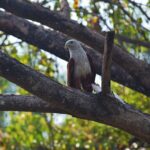
A very lucky sighting we had was of a Crested Hawk Eagle. It was sitting low down in the trees, not far off the road.
We spotted some rhesus macaques out in the treetops.
While driving outside of the park, we also saw a few grey langurs.
We saw the crested hawk eagle our last jeep ride through the park in the evening of July 31. That day we had ventured pretty deep into the park, hoping for a tiger or leopard sighting with no luck. As we finished taking pictures of the hawk eagle, we noticed that the cloud cover was starting to increase.
The rain started slowly at first, just a slight drizzle. But before long, it started to increase. I only had a cloth backpack, so I took out my phone and held it so I could protect it with my body, along with the camera. Because of it’s open sides, the jeep offered little protection from the wind driven rain. Still, as long as we huddled near the center of the jeep we were okay.
Then, with a whoosh, the real storm arrived. The rain began to stream off of the top cover of the jeep, drenching the seats. The driver started racing back toward the visitor center, still a couple of miles away. Because of the gap between the front cab of the jeep and the top cover, this meant the rain was now driven straight into our faces. It was a cold, wet, miserable drive back, leaning over my camera and phone to keep them dry.
Finally, we arrived back at the guest house, completely soaked through. Happily all of the electronics survived no worse for the experience, and we quickly found changes of clothes. And of course, within a few minutes the rain let up and returned to just a slow drizzle. Figures.
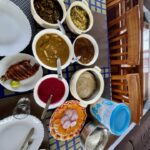
There was only one cafeteria within the visitor center, so we had most of our meals outside of the park. For dinners, we went down out of the park to a resort run by the forest service. They had a nightly dinner buffet with an array of different Indian dishes, all very tasty. The dining area was in screened outside gazebos. Because the lighting wasn’t very bright, I didn’t end up with any clear pictures. There is no cell phone data connection or internet connection within the park, so dinner was the only time of day when we had internet access.
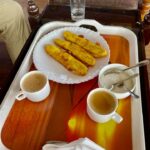
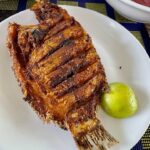
For breakfast and some lunches, we went to the Banyan restaurant, which was run by the local tribal minority group. The food there was also excellent.
The Banyan restaurant was just down the hill from an elephant camp, which I will write about in another post. One morning when we arrived for breakfast, there were two elephants down in the river below getting baths!
While in staying in Bandipur, we visited several other places outside the park as well. The next couple of posts will tell about those trips.
 Mervin