
[googlemaps https://www.google.com/maps/embed?pb=!1m28!1m12!1m3!1d875956.6183796356!2d76.63862742905715!3d12.706865933415974!2m3!1f0!2f0!3f0!3m2!1i1024!2i768!4f13.1!4m13!3e0!4m5!1s0x3bae1670c9b44e6d%3A0xf8dfc3e8517e4fe0!2sBengaluru%2C+Karnataka!3m2!1d12.9715987!2d77.5945627!4m5!1s0x3baf7777dd032e0b%3A0xdfd27aad93e2bc43!2sRanganathittu+Sanctuary%2C+Mandya%2C+Srirangapatna%2C+Karnataka+571438!3m2!1d12.4243603!2d76.6563492!5e0!3m2!1sen!2sin!4v1502182206366&w=400&h=300]
Saturday, July 30
The first leg of our car trip took us from Bangalore (Bangaluru on the map) to Bandipur Tiger Reserve, a distance of about 150 miles. Along the way we stopped at a bird sanctuary about 3 hours from Bangalore called Ranganathittu. It is the largest bird sanctuary in the state of Karnataka, covering about 40 acres. Many local bird species live there year round, but it is particularly known for the large influx of migrating birds that arrive during December.

We arrived in the late morning, narrowly beating a rush of 300 visitors invited by a local politician. Dr. Johnsingh was greeted by a forest officer on arrival, and he guided us on a pathway along the lakeshore until we reached a boat launch where we could board the wide bottomed boats. Here are Mervin and I, wearing the fashionable life jackets:
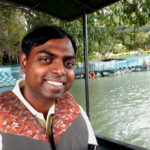
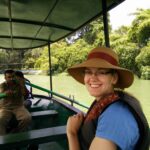
Although the boat could hold at least three across on each bench, we had a private tour with just Mervin, his dad, me, and our driver. Just behind me in the picture above, you can see the oarsman who rowed the boat for us with unwieldily looking heavy wooden oars, an impressive feat of strength and skill.

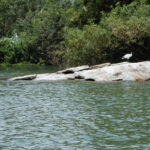
The lake is surrounded by trees and contains several islands where the birds enjoy roosting. Click each picture to make it bigger.
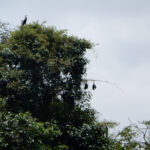
Hanging from the trees around the lake were numerous fruit bats. They are the black shadows hanging from the tree branches if you look closely at the pictures.
There were more than just birds in the sanctuary:
Mugger crocodiles! These freshwater crocodiles can grow to be up to 16 feet long, and eat fish, birds, reptiles, and smaller mammals. They are considered to be far less dangerous than saltwater crocodiles and only occasionally threaten humans. We saw quite a few floating near the shore, but none of them came close.
The boat gave some great opportunities for close up views of the birds. The all white birds are Little Egrets, and the gray bird with the long beak is an Openbill Stork. The white bird with orange on its head is also a Little Egret, but in breeding plumage.
We finished up our boat ride just as the large group was starting out in their many boats.

After our ride we went to a small restaurant at the park for some lunch. The food was good, and the mosquitoes thought we were equally tasty. Since it was back in the trees, there were plenty buzzing about. I also saw a very large bee hover around the edge of the open sided rooftop, and was glad when in seemed content to just continue along its way.
Finishing lunch, we went back to the car and made our way to the next stop, Mysore Palace.